the opening ceremony of the “2026 Weifang Chen Jieqi Stone and Seal Culture Week” was held in Weifang, China. Through a series of events — including a special exhibition of ancient pottery inscriptions, an exhibition of seal-carving exchanges from home and abroad, and the release of a database — the outside world can trace, starting from a single ancient seal, the thousand-year lineage and contemporary transformation of Chinese epigraphy.
At the entrance of the Wanyin Tower, many people’s first reaction is: how has a city known for kites, and strong in agriculture and manufacturing, turned “ancient characters on stone” into a place the whole world wants to see? This year, 14 collectors and institutions from home and abroad donated 2,523 pieces to the Chen Jieqi Stone and Seal Museum free of charge, including 1,626 ancient pottery inscriptions and 310 ancient clay seals. Together with its existing collection, the museum’s total holdings of ancient pottery inscriptions have reached 4,000 pieces — precisely the “four thousand kinds of pottery inscriptions of Qilu” spoken of by the Qing Dynasty epigrapher Chen Jieqi 142 years ago.
In the same courtyard, the exhibition displays all 1,000 seal-carving works from 19 countries and regions, including Japan, South Korea, Singapore, Malaysia, the United States, France, and Germany. Each small stone places creators from different linguistic backgrounds — East Asia, Southeast Asia, Europe, and the Americas — in dialogue within the same space and time.
Outside the courtyard, five academic institutions signed strategic cooperation agreements with the Chen Jieqi Stone and Seal Museum. The universities contribute research and students, while the museum contributes objects and exhibitions, bringing epigraphy out of scholars’ studies and into university classrooms and city streets. A cloud-based database released at the same time puts seal catalogues and rubbings online, so researchers can consult ancient scripts without flying to Shandong. The China-Japan-South Korea Center for Stone and Seal Carving Exchange and Mutual Learning, established in Weifang in 2022, continued to serve as an institutionalized international platform during this year’s Culture Week, with authors from Japan, South Korea, and other countries truly sitting down for face-to-face dialogue.
One more detail is worth noting: the Chen Jieqi Stone and Seal Museum only opened in November 2024, yet in less than a year it has received more than 100,000 visitors, held over 100 study programs, and compiled and published five research works. Weifang has not locked epigraphy away within academic circles; instead, it has created exhibitions, databases, and cultural and creative derivatives, bringing an ancient seal out of the glass case in the Wanyin Tower and turning it into a cultural asset the whole city can share.
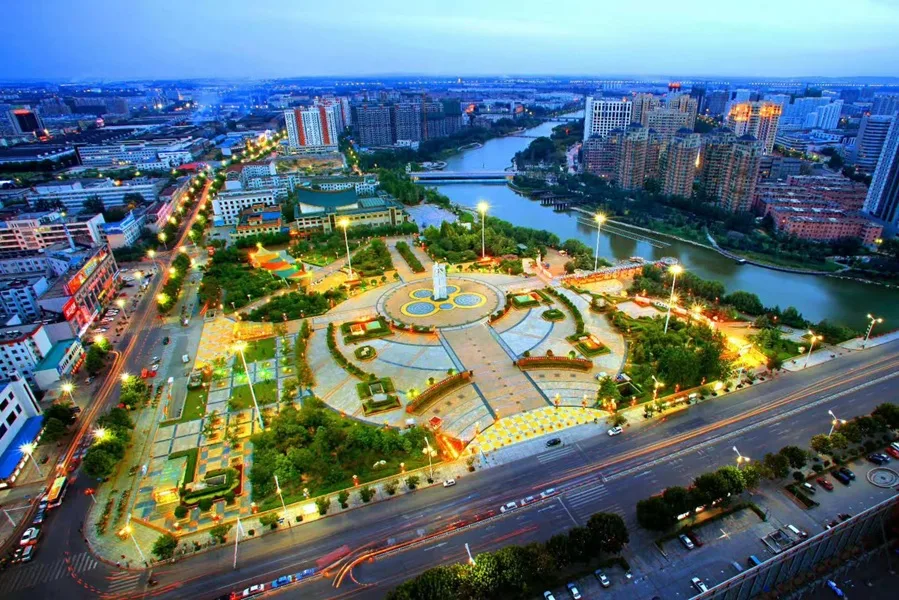
Weifang is a National Famous Historical and Cultural City announced this year by the State Council of the People’s Republic of China. Epigraphy is a calling card Weifang offers to the world — but it is not the whole story.
In the Weifang Intangible Cultural Heritage Museum, nut carving, New Year paintings, paper-cutting, kites, and clay sculpture all carry the names of their inheritors, along with workshop addresses and contact information. These intangible cultural heritage works, systematically organized and warmly presented, have all come into public view. Here, intangible cultural heritage can be seen with the eyes and made with the hands, allowing traditional crafts to be passed down from generation to generation.
Not far away, the Weifang World Kite Museum sends another kind of imagination into the sky. A dragon-head centipede kite winds and coils with a body dozens of meters long, while a soft kite themed on China’s space station replicates the outline of a spacecraft using modern materials. Weifang kites, included in the first batch of national intangible cultural heritage in 2006, carry within them the perception of wind, an aesthetic of color, and the memory of legends.
Heading south along the old Jiaoji Railway line, Fangci Town preserves time in another way. Its 166 modern-era buildings have not been demolished, nor have they been turned into uniform commercial districts. They remain where they are: a café has moved into the old post office, handicraft shops have moved into former foreign trading houses, and young people drink tea, take photos, and chat beneath century-old red tiles. Fangci Town shows that a city’s way of treating history can be to quietly let it stay, and then let new life grow naturally into it.