
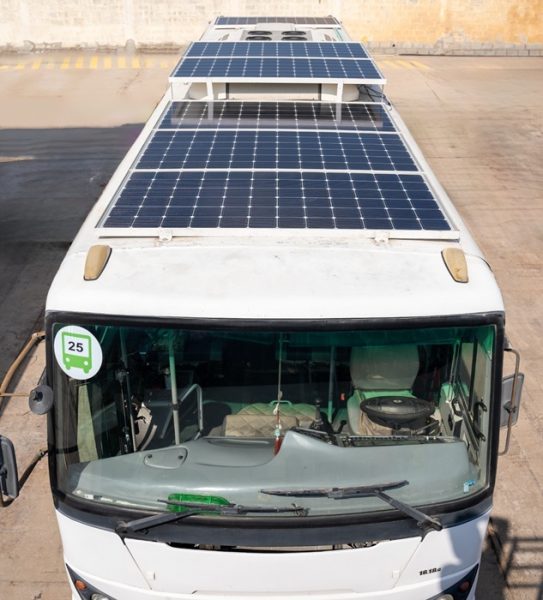
AVZ, a UAE-based sustainability innovation company, recently rolled out its GreenTrans Solar Bus System, a first-of-its-kind advancement that converts heavy vehicles into clean energy platforms. By harnessing the untapped rooftop space, the system generates renewable power for critical onboard operations, sharply reduces fuel dependency, and reinforces the UAE’s leadership in sustainable transport and green innovation.
Founded by visionary entrepreneur Vipen Ruhela, Chief Executive Officer, and interdisciplinary scientist Dr. Zoltan Derzsi, Chief Technology Officer, AVZ focuses on developing solutions that are safe, affordable, and adapted to the Emirates’ climatic conditions. The GreenTrans Solar Bus System is their first step and a powerful demonstration of their philosophy of energy independence, unlocking new frontiers in public transport efficiency while directly contributing to the nation’s sustainability roadmap.
Innovation Highlights
Harnessing Automotive Traffic as Real Estate
Traditional solar installations require around 10 square meters of area to produce one kilowatt of power. Most heavy vehicle provide between 22 and 24 square meters of rooftop, enabling installation of 12 to 18 square meters of solar panels. Across 10,000 buses in the Emirates alone, this would produce between 39 to 59 million kilowatt-hours annually.
Energy Storage in Hostile Environments
The energy produced is stored and used directly to power air conditioning systems, which are among the most demanding auxiliary functions in hot climate countries. By easing reliance on diesel-powered AC engines, the system helps reduce both operational costs and emissions.
Use of Artificial Intelligence for Fault Prediction
Air conditioners are mechanical devices that display subtle signs before breaking down. With an AI-based solution, AVZ’s system detects these faults before they become catastrophic. This prevents the leaks of refrigerant gases, which have several thousand times more environmental impact than carbon dioxide alone.
Environmental and Economic Impact
The innovation significantly cuts carbon emissions, expands the country’s solar footprint without the need for additional land, and minimizes storage and transmission losses. The result is a clean, efficient, and scalable system that generates tangible environmental and financial returns.
New Approach in Open Science and Intellectual Property
Technologies for the common good are unethical to profiteer on: while the core neural network code is released to the Open Science Foundation so it can be implemented by other parties, the data used for training remains the property of the company. This heralds a new approach in applied science in the GCC region, with the aim of building up a team of engineers and scientists to solve problems impossible otherwise.
Energy- and infrastructure independence in research, development and production
AVZ’s other design is a self-sustaining technology park that is self-reliant on energy and water management: electricity is produced locally, and waste water is recycled. Research, design and production is taking place in the same facility surrounded by gardens, with little to no prior infrastructure requirement.