

For nearly 30 years, a 59-year-old South African national, Keith Lukin, lived with progressive shoulder arthritis that gradually reduced his mobility to just 10%. Over time, even the simplest daily activities—lifting a cup, reaching overhead, driving, or dressing—became difficult.
Over the years, he sought medical help across multiple centers internationally, undergoing countless physiotherapy sessions and repeated intra-articular steroid injections. Despite these interventions, the condition continued to deteriorate, with no lasting relief.
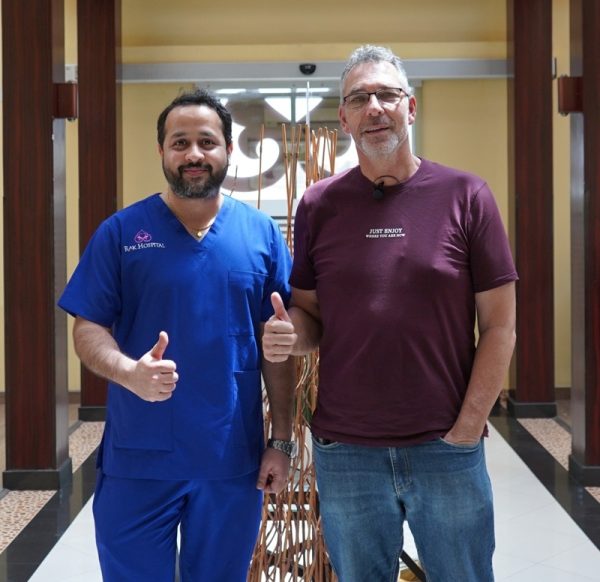
It was only when he arrived at RAK Hospital that a clear diagnosis was finally made. Under the care of Dr. Bharath Patil, Orthopedic Surgeon, advanced imaging including MRI and CT scans revealed severe degeneration of the shoulder joint, with complete loss of cartilage resulting in a “bone-on-bone” condition, which severely restricted his daily movement and ability to perform simple tasks.
Following a comprehensive evaluation, Dr. Patil recommended a bilateral anatomical total shoulder arthroplasty—a complex joint replacement procedure in which the damaged shoulder joint is replaced with an artificial implant designed to closely replicate the natural anatomy of the shoulder. The goal of the procedure is to relieve pain while restoring smooth, near-normal shoulder movement and function.
The surgery was planned in two stages, beginning with the dominant shoulder, followed by the second after successful recovery and rehabilitation.
Explaining the case, Dr. Patil said, “In advanced shoulder arthritis, where cartilage is completely worn out, patients often reach a stage where conservative treatments are no longer effective. In this case, the rotator cuff muscles were healthy, which made anatomical shoulder replacement the most suitable option.”
“We chose this approach because it offers superior range of motion and exceptional long-term survival rates compared to other options,” added Dr. Patil. “Furthermore, by preserving the anatomical structure, we ensured that if any revision surgery is required decades into the future, the option for a reverse shoulder replacement remains available.”
Adding further, he said, “Moreover, this case represents an important milestone for the region. We are proud to say that this is a significant medical advancement for the Northern Emirates, with RAK Hospital successfully performing a rare and life-changing procedure locally for the first time. After years of unbearable pain, the patient finally found relief here in the UAE, which reflects our ability to deliver advanced orthopedic care at par with international standards, right at the patient’s doorstep.”
Dr. Patil also highlighted a growing regional trend. “While most cases are seen in the 55–60 age group, we are increasingly diagnosing younger patients due to sedentary lifestyles, reduced physical activity, and obesity-related factors. At the same time, many people continue to normalise pain or delay seeking help due to fear or misconceptions that surgery is the only outcome.”
He added that treatment in orthopedics always follows a structured approach. “We never begin with surgery. Patients are first managed with medication, physiotherapy, and injections. Surgery is only recommended when these options fail or when the disease is already advanced.”
Looking back, the patient admits that years of living with pain had gradually become his normal—until he understood that it did not have to be.